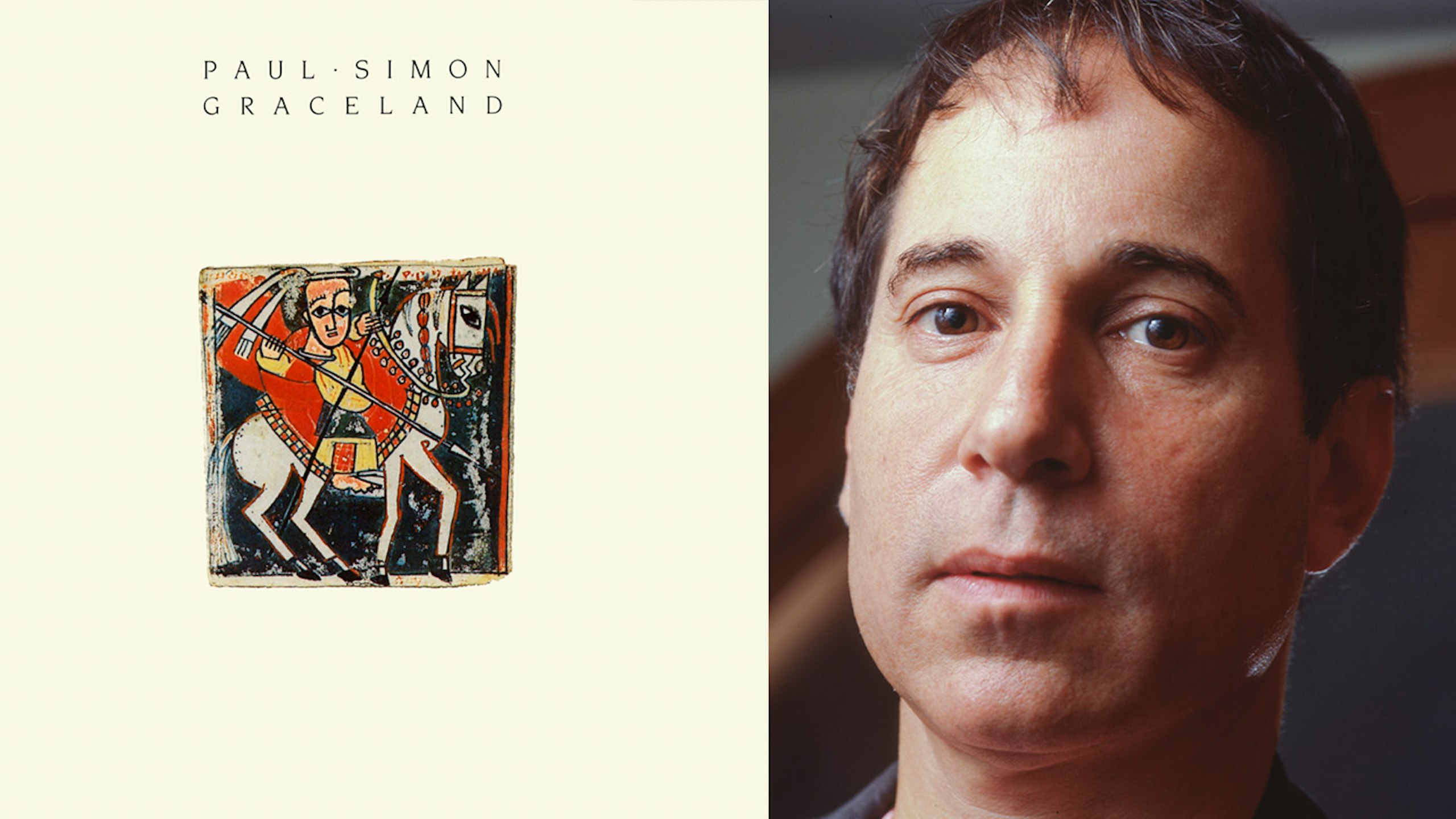
When Paul Simon travelled to South Africa in 1985, he was a major artist down on his luck, seeking inspiration for his next album. What he found was a new way of making music, and a political and ethical nightmare. On the anniversary of Graceland’s release David Hutcheon speaks to the artists involved about the turmoil of the times…
As the sun set over the Rufaro Stadium in Harare, Zimbabwe, on February 14, 1987, a feeling of love was in the air. Paul Simon stepped forward to announce: “We’re going to close by singing the African national anthem.” Miriam Makeba, as near to South Africa, her homeland, as she had been in 27 years, took the lead; Hugh Masekela, also exiled from the republic, played a flugelhorn solo; and Ladysmith Black Mambazo, still residents of the country, provided peerless backing. While N’Kosi Sikelel’ iAfrika, a Methodist hymn written in the Xhosa language 90 years before, filled the venue, 20,000 black and white people held hands in the air, some in a spirit of reconciliation, some in friendship, all in defiance of apartheid. If only everything to do with the Graceland album had been so harmonious.
“It was the first time I’d ever played in Africa,” Simon told MOJO in 2012, agreeing that this was a highpoint of the most successful – and controversial – period of his solo career. “It was as close to a homecoming as was possible, as Miriam and Hugh weren’t allowed into South Africa. It was just very exciting and the music, the admiration for world music being represented in a form that was embraced by everybody, it was a big hit. Of course, the political debate followed us: the editorial of the newspaper in Harare called us ‘Disgraceland’.”
The 1980s had not been kind to Paul Simon. After the success of his three albums immediately post Bridge Over Troubled Water, inspiration had become harder to find; both One-Trick Pony and Hearts And Bones had underperformed. Perhaps even more dishearteningly, the live album he had recorded with Art Garfunkel in New York’s Central Park in 1981 had gone double platinum. Had his time passed? Was he now a washed-up nostalgia act? In Under African Skies, Joe Berlinger’s impressive documentary about Simon’s Graceland adventure, he claims to have approached the downturn with optimism: “Good, nobody will be looking over my shoulder next time.” He could do something that interested him because nobody else was interested in Paul Simon.
His fire was reignited in 1984 when a friend gave him a cassette labelled Gumboots: Accordion Jive Hits No 2. In the sleevenotes to Graceland, he says: “The instrumentation made me think [it] hadn’t been recorded by an American or British band.” Indeed, it was The Boyoyo Boys, a South African outfit produced by Hilton Rosenthal, who had formerly been head of CBS’s South African black-music division and now worked for Warners.
“It was township jive; accordion, guitar, bass and drums, very elemental stuff,” remembers Simon. “Because it was all instrumental, I could improvise melodies over it. Elements reminded me of bits of American music I had heard, that’s why I felt as at ease with it as I did. It was very much like a certain kind of mid-1950s music. In my mind, I could relate to it in that way. I could sing old songs against it.”
He asked Rosenthal if there was anything else he should be listening to, and 20 more albums appeared in the post. Mbaqanga, mgqashiyo, isicathamiya… the names of the styles are as irrelevant as they are intimidating. Simon was hooked. And it wasn’t just rock’n’roll he was reminded of: kwela (pennywhistle jive from the 1950s) undoubtedly shared a groove with ska.
“When I lived in Britain in the 1960s, it was the height of the ska. I tried to record Why Don’t You Write Me, on the Bridge Over Troubled Water album, as ska, but I was in Los Angeles with American musicians, and it didn’t sound right. It’s no use asking musicians in LA to play like musicians in Jamaica, it can’t be done. When I wanted to record Mother And Child Reunion in 1971, I called up the guy who recorded Jimmy Cliff and said I’d like to come and record down there. So I understood you gotta go where the musicians are if you want to get the right sound, and that’s what happened with Graceland. I went to South Africa because that’s where the music was.”
And that’s where the trouble began, because South Africa wasn’t like any other country. Since 1948, the ruling National Party had enforced a policy of racial segregation and separate development, not just between black and white (and Asian and “coloured”), but between different tribes. South Africa was not one country but a federation of 11 whose black residents were denied citizenship and voting rights and forcibly removed to 10 ethnic homelands, the bantustans, passbooks controlling their freedom of movement.
The government also adopted an authoritarian attitude towards music, particularly after jazz gave performers something distinctly black and powerful to play with. Rock’n’roll thus fell foul of radio programmers for both the white and black stations, and the government controlled the supply of new music, preventing the sale of imported records and deciding what local labels could release. Not until Englishman Mickie Most moved to South Africa, in 1959, did authentic home-grown rock appear, when he recorded the black singer Abia Themba and white Hammond wizard Cherry Wainer.
There was little crossover between races. Whites had a diet of imported rock and local heroes such as John Kongos; thrown together in the bantustans, blacks created their own stew, mbaqanga, a mix of ethnic styles. The first notable mixed-race group, Juluka, featuring Johnny Clegg and Sipho Mchunu, formed in 1969 and played clandestine gigs for 10 years – during which time Clegg was frequently arrested and beaten – before being able to record their debut album.
“I was into blues and soul,” recalls producer/compiler Trevor Herman, “then I looked into some local music. There were very few whites doing that at the time, I was the only one of my friends. When I went to the black record shops in Cape Town, this is around 1970, I was the only white who was asking for Mahlathini records. There must have been more, some jazz guys who collaborated with black artists, even though it wasn’t legal. The thing was, the University of Cape Town was a private organisation, so black people could play for whites – I saw Philip Tabane there – but they couldn’t play in public theatres.”
The Establishment’s wide-ranging control meant any music that pushed against apartheid was doomed to be rarely heard outside clubs in black townships. If you wanted your music to be heard, you sang about innocuous subjects. Dorothy Masuka’s Dr Malan’s Government Is Harsh was a rare example of a protest song that received airplay, but shortly after its release, the singer found herself unable to return home from a gig in Rhodesia. As the ethnomusicologist Charles Hamm argued while slating Graceland in 1989, those who achieved success in South Africa found themselves on the wrong side of the argument at home, as their music “lost all meaning for the new generation of black South Africans strongly politicised… and drawn to mbaqanga.” Music, however it was proscribed, remained a source of power for the oppressed, as Masekela argued in the film Amandla!: “You can’t beat these people physically, but you can scare them with the songs.”
In Berlinger’s documentary, Simon asks Quincy Jones: “Why are the politicians considered experts?” It’s a good question, for as the United Nations enforced a series of boycotts to put pressure on the South African government, Ronald Reagan and Margaret Thatcher promoted a policy of “constructive engagement”, which would end apartheid, they argued, by easing sanctions and rewarding the white minority for preventing the spread of communism.
In 1985, the luxury resort of Sun City, in the bantustan of Bophuthatswana, became the focal point of this war against the reds. Frank Sinatra, Queen and Tina Turner were among those lured to play there as the government strove to circumvent the boycott. Paul Simon turned down the large cheque offered, but also baulked when Steve Van Zandt asked him to sing on his Sun City single, alongside, among others, Bob Dylan, Bruce Springsteen and Miles Davis. It wasn’t the message (“I ain’t gonna play…”), it was the fact that the original lyrics named those who had performed there, including his friend Linda Ronstadt. He wasn’t alone, as Joni Mitchell told The Guardian in 1986. “I know Linda played there in all innocence, being an apolitical creature who felt that art should cross any border. I’m not opposed to that point of view. I don’t see her as having committed any great crime.”
A further artefact hitting international markets in 1985 was The Indestructible Beat Of Soweto, compiled by Herman and released on the Earthworks label. “They’d put out a thing called Zulu Jive,” says Herman, “and that had second-division artists on it. So I told them, Look I’ve got the best music, let me compile something and put the proper stuff out.” Featuring acts such as Nelcy Sedibe, Simon ‘Mahlathini’ Nkabinde and Ladysmith Black Mambazo, it didn’t get much mainstream radio play, but was hailed by Village Voice’s Robert Christgau as “the most important record of the 1980s”, it primed critics for the album Paul Simon was quietly working on.
After talking to his label, who suggested recording in America, and friends such as Harry Belafonte, who advised seeking permission from the African National Congress (ANC), which represented the majority of black South Africans, Simon travelled to Johannesburg in February 1985. Rosenthal had arranged studio time for his favourite bands – Stimela, a soul band featuring the guitarist Ray Phiri; Tau Ea Matsekha, a Lesotho band led by accordionist Forere Motloheloa and bassist Baghiti Khumalo; General MD Shirinda And The Gaza Sisters, who came from Gazankulu; and The Boyoyo Boys, reformed especially after the death of their drummer – and now it was a case of reassuring them that they wouldn’t get into trouble for breaking pass laws, sitting back and seeing what happened.
Footage of the sessions makes the time Simon spent working with the bands look like a party from start to finish, but just by being there he opened himself up to attack. First, he hadn’t spoken to the ANC and had broken a boycott created to prevent South Africa having any sort of exchange with the outside world. He had been cleared by the local musicians’ union, who didn’t object to him recording with its artists if they weren’t being exploited – he was paying three times American union scale – but the politicians’ approval had not been sought.
“In a way, Paul was very lucky to be caught in the political impasse,” says Phiri. “All the controversies brought attention to the album, and the world said, ‘Let’s give it a listen. What is this Graceland?’ It helped revive his career and got the political experience of the South Africans known by the world. We were conduits of good and bad news.”
“I’m glad, in retrospect, that it happened,” Simon told MOJO, “because my point is that it’s absurd for political parties to tell you what morality is. In the case of the ANC, they had a case that was morally righteous, but it wasn’t that they were inherently good and moral. All of these political parties use artists when it suits them.”
In what way was his presence in South Africa a breech of UN policy while the Earthworks compilation was not? “It didn’t make sense to boycott the people you were trying to help,” says Herman. “The boycott was understandable, but those who were into the politics wanted a simple solution and it’s difficult to be hardline. There are always exceptions. I hung out with the musicians, I gave them copies of everything, we discussed it. There wasn’t much difference between what we did and what he did.”
“Those arguments never really bothered me,” adds Phiri. “They became part of what needed to be exposed. We who grew up in South Africa, who were on the front line of the battle, we decided to come out and tell our own story and expose the evils of apartheid. Who could tell it better than us? Instead, the very same people I was trying to help said: ‘Ray Phiri is a sellout, a collaborator, he broke the cultural boycott.’ Fortunately, I don’t have time to whine or be bitter.”
The second criticism is one of cultural imperialism. Here was a rich white guy benefiting from the use of people who could not take part in a free exchange of ideas, according to the pressure group Artists Against Apartheid, because they simply weren’t free. A Google search turns up this argument by journalist Jan Fairley: “The people he worked with were brilliant and he was just a copyist, jumping on their bandwagon.” So what did he bring to the studio?
“With the exception of Gumboots, which was written before I arrived, I didn’t have anything and
everything was made up there. If they didn’t understand what I was talking about conceptually, once we recorded it and they came into the control room, they could see what I was doing, merging this sound with that sound. I was changing the music from what they were playing, I was putting bridges in and other forms to make it closer to something I would be able to work with post-recording, something akin to our popular music.
“This was another way of making songs that was different from sitting in my room with a guitar and making up songs, but I really didn’t want to use that method anymore. I wanted to make a record that I liked and then worry about the songs, as opposed to writing the song and going in and showing it to musicians and hopefully getting the record that I wanted. A fair percentage of the time I’d not got what I wanted doing it that way.”
With South Africa heading for a state of emergency, Simon soon decided to leave with five songs recorded, including The Boy In The Bubble, Graceland and I Know What I Know. Three months later, he invited Phiri, Khumalo and drummer Isaac Mtshali to New York for sessions that produced You Can Call Me Al and Under African Skies. After that, things slowed down. More studio time was booked, involving South African expat Morris Goldberg on pennywhistle and sax, King Sunny Ade’s pedal-steel player, Demola Adepoju, Don and Phil Everly and, more controversially, Sun City veteran Ronstadt – Simon was “using gasoline to put out birthday candles” argued critic Nelson George. He was also trying to find a way to connect this music with something familiar to his audience.
It’s well documented that disputes over credits on the two tracks that resulted from sessions with the zydeco band Rockin’ Dopsie And The Twisters and Los Angeles Chicano rockers Los Lobos caused
hostility between the participants, so – although there has been no directive to avoid the subject when interviewing Simon – MOJO decides to take a different tack. After all, Graceland “opens” with nine exceptional songs based on South African music, then sticks two inferior recordings on at the end, disrupting the arc of the album and changing the mood entirely. What was that about?
At the mention of Los Lobos, the atmosphere in the room changes. A press officer moves toward the door, Simon looks away pensively, his words slow.
“Well, I ran out of ideas with the Africans. We had a few other cuts that didn’t make it, but those that did were sufficiently different and interesting, then I didn’t know where to go, so I thought I’ll do zydeco with an accordion. I didn’t really know that was going to work, but the reason I went looking for additional songs was because I ran out of good ideas.”
Almost a year later, after corresponding with lead singer Joseph Shabalala by mail, Simon met Zulu a cappella group Ladysmith Black Mambazo in Abbey Road, quickly arranging and recording arguably the LP’s greatest selling point, Homeless. With the album due to appear in June 1986, the Graceland band and Ladysmith were booked on Saturday Night Live in May, only for Warners to move the release date to the autumn. With time to kill, the ensemble worked up an entirely new song, Diamonds On The Soles Of Her Shoes, and performed that for the TV audience. The response was such they were immediately back in the studio for one final session.
When the LP appeared, it was greeted with almost unanimous approval… for about a month. Then people started asking questions, not on the ‘Graceland’ Simon was singing about, but the pariah state he had recorded in. He was accused of imperialism, profiteering, sanction busting, legitimising the apartheid government and of stealing South African music to give a veneer of interest to “typically insular” lyrics. Artists Against Apartheid called for a boycott of the album and the United Nations threatened to blacklist him, although he argued he hadn’t broken any sanctions as he hadn’t performed in South Africa.
“When you’re being attacked, your first instinct is to say, I didn’t do anything wrong,” he says. “Not: You’re the guys who are stopping your own people from showing their music and their culture to the world. When the world heard what we’d done, the struggle became humanised. When you see people whose music you love and they have to go back to a country where, by law, they can’t move from where they are, where they can’t vote, where they are deprived of all rights of citizenship, you look at that and you say this is an outrage. I think that Graceland – not intentionally – exemplified that concept.”
In an attempt to defuse the situation, Simon appeared at Howard University in Washington, but the move backfired, as Berlinger’s film shows in its most visceral sequence. A verbal attack by student Mark Batson – “For too long artists have stolen African music. It happened with jazz. You’re telling me the Gershwin story of Africa” – leaves the singer visibly distressed. Batson himself is now a big wheel in music, his name a regular credit on albums by Eminem and Dave Matthews, who was born in South Africa. Phiri’s take on who the music belongs to is more poetic: “Paul Simon wrote about the diamonds but he doesn’t own the mine.”
Then came the tour, with Masekela and Makeba on board, at the former’s suggestion, to give the tour both anti-apartheid credibility and a conundrum for critics. If the press asked the horn player why he was there, says Simon, his response was: “What the fuck did you ever do for South Africa?” But more worrying, perhaps, was the fact that the Pretoria government appeared to love the album, acclaiming it as proof constructive engagement and – bizarrely, surely? – separate development worked. It soon sold 150,000 copies, making it the country’s biggest hit since Thriller.
There was, fortunately, a resolution that suited all sides. Graceland sold 14 million copies worldwide; Ladysmith Black Mambazo became superstars, topping international album charts with their best-of, The Star And The Wiseman; Khumalo remains one of Paul Simon’s go-to guys for recording and touring; and Phiri was awarded a lifetime-achievement award by the South African music industry in April. More importantly, apartheid itself collapsed, withering after the release of a number of imprisoned political activists in 1990. Everybody wins.
With the passing of time, it has become acceptable for those who lined up against the album, such as Fairley, Billy Bragg or Artists Against Apartheid’s Dali Tambo, to admit to loving the music. In 1992, Simon was invited by the musicians’ union to perform in South Africa and he met the country’s future president at an ANC reception after the gig. And, frankly, if Graceland got the thumbs up from Nelson Mandela…
“I have to say this,” says Herman, “for a lot of those musicians, that’s the most African album they’ve played on. That’s a fact. It’s ironic, but for Ray Phiri, for example, you’re not going to find something that he played on that’s more African than that album, and Paul Simon pulled out the best from the guy.”
When he speaks to MOJO, Paul Simon is in London talking about reuniting with the musicians for European dates this summer and accepts that marking the 25th anniversary of Graceland opens him up to questions on issues he feels were resolved years ago.
Is he enjoying the process? “Not entirely.”
Any regrets?
“Had somebody said to me, ‘Look, we really don’t want you to go there,’ I doubt I would have gone, but nobody did, so I was unaware of what was happening. As for regrets, no, I don’t have any because it’s a happy ending.”
The last word, however, belongs to a South African. “Graceland was 25 years ago,” says Phiri. “So am I not lucky? I’m fortunate because I’m part of a troupe of people with a conscience. Maybe mistakes were made, but who are we to be judgmental? And I don’t care who made those mistakes, the bottom line is we moved forward as a people and as a country.”
This article originally appeared in MOJO 224